
Office Syndrome — Targeted, Systematic Treatment for Work-Related Neck, Shoulder, Upper-Back and Back Pain

Symptoms ofneck, shoulder, upper-back and back pain tightness around the shoulder blades, occipital headaches, or numbness radiating down the arm are increasingly common among today’s workers—especially those who spend long hours at a computer, frequently use smartphones, drive for extended periods, or repeat the same posture every day. Many assume these symptoms are simply part of working life and leave them untreated until they become chronic and interfere with work, sleep, and quality of life.
At KIN, we do not regard Office Syndrome as ordinary muscle fatigue. It is a problem involving the muscles, movement patterns, and body-use behaviors that requires proper assessment. KIN has a clearly structured Office Syndrome program supported by arehabilitation medicine physical therapy and occupational therapy team, with PMS, Shockwave, Laser and Ultrasound available within one integrated system at KIN Wellness
1. Why Office Syndrome Should Not Be Ignored
Office syndromemay begin with minor symptoms such as neck tightness, shoulder fatigue, or back stiffness in the evening. When the body continues performing the same work patterns every day, these symptoms can gradually accumulate and become chronic pain, tension headaches, poor sleep, numbness radiating down the arm, or reduced work performance.
Effective treatment should not stop at massage or temporary muscle relaxation. It should examine how sitting posture, monitor placement, mouse use, bending the neck to use a phone, and each person’s muscle-tension patterns contribute to the problem—and how these factors can be adjusted for long-term improvement.
2. What Is Office Syndrome? — Causes and Symptoms You Should Know
Office Syndrome is a group of pain, tightness, numbness, or discomfort associated with repetitive work and remaining in the same posture for too long—for example, sitting at a computer for hours, frequently looking down at a phone, attending continuous meetings, driving for long periods, or regularly working in an imbalanced posture. Although common among office workers, it can affect students, freelancers, drivers, vendors, and anyone who uses a smartphone for extended periods.
Common Symptoms
Neck, shoulder and upper-back pain · Pain around the shoulder blades or upper back · Occipital headaches · Neck stiffness or limited rotation · Numbness radiating to the arm or hand · Pain after only a short time working · Neck or shoulder stiffness upon waking
Common Causes
Prolonged uninterrupted sitting · A monitor or desk that does not suit the body · Frequent smartphone use with the neck bent · Unconsciously elevating and tensing the shoulders while working · Imbalance in the neck, shoulder-blade and core muscles · Insufficient rest and accumulated stress
For this reason, two people who both say they have “shoulder pain” may have entirely different causes. AnOffice Syndrome treatment approach that is identical for everyone may therefore fail to provide a long-term solution.
3. Why Choose KIN for Office Syndrome Treatment — Addressing the Cause, Not Just the Pain
First difference — KIN has aclearly defined Office Syndrome programwithin its actual service structure. The condition is not grouped together with every other type of pain. The KIN team views it as a specific pain pattern with its own characteristics that requires a specialized plan.
Second difference — KIN provides acollaborative care structureinvolvingrehabilitation medicine physicians physical therapists, occupational therapists, and sports scientists. Care therefore goes beyond pain reduction to address work posture, repetitive movement, and the impact on the patient’s real daily life.
Third difference — KIN providesmultiple technologies in one location including PMS, Shockwave, Laser, Ultrasound and Electrical Stimulation. This allows treatment to be selected according to each patient’s condition. Some patients need inflammation reduction, others need muscle relaxation, muscle activation, or movement-pattern rehabilitation in combination.
Most importantly, KIN does not aim only to “reduce pain.” The goal is to help each patientgenuinely return to work and daily life with better function —such as sitting and working longer without fatigue, turning the neck more comfortably, experiencing less pain during the day, and reducing repeated flare-ups.

4. Technologies Used by KIN for Office Syndrome Care
| Technology | How It Helps with Office Syndrome |
|---|---|
| PMS | Stimulates peripheral nerves, helps relax muscles tightened by prolonged sitting, and supports imbalanced muscle function. |
| Shockwave Therapy | Suitable for chronic pain around the shoulders, shoulder blades, or areas with accumulated scar tissue; stimulates tissue regeneration. |
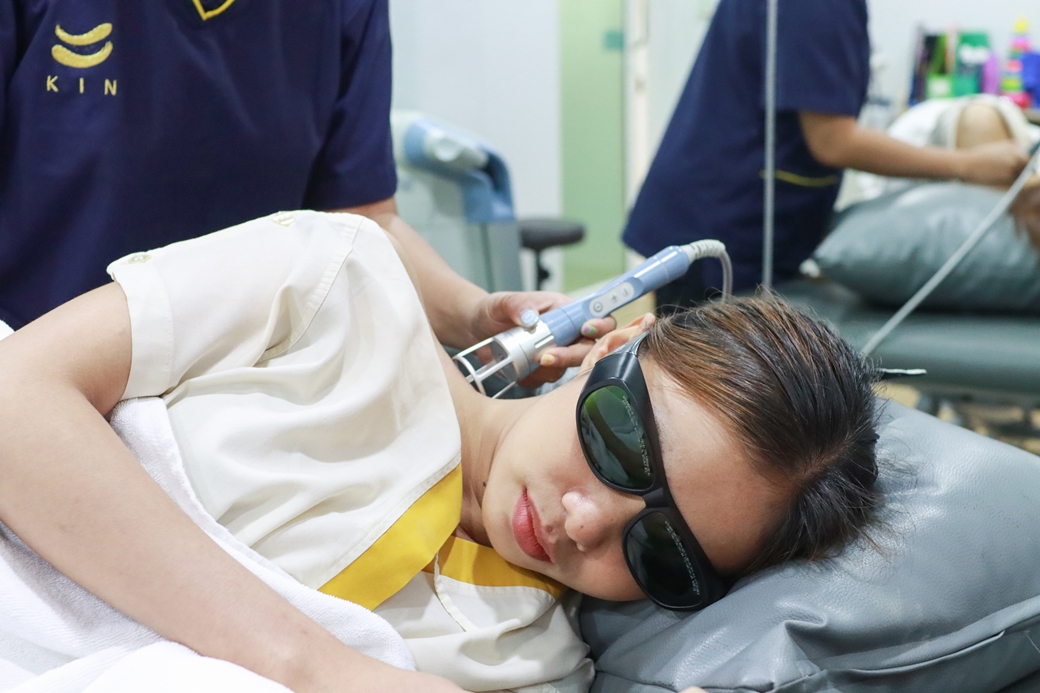
| Laser Therapy | Reduces inflammation and pain and promotes tissue repair; suitable for chronic muscle tightness around the neck and shoulders. |
| Ultrasound Therapy | High-frequency sound waves help relax deeper muscles and reduce tightness and pain. |
| Electrical Stimulation | Stimulates muscles and reduces pain using TENS/EMS; used with the physical therapy plan to enhance outcomes. |
5. Who Is Office Syndrome Treatment at KIN Suitable For?
| Service User Group | Symptoms / Needs |
|---|---|
| People who spend long hours at a computer and developNeck, shoulder and upper-back pain | Symptoms caused by prolongedsitting and workingthat begin to affect performance, requiring targeted treatment and recurrence prevention. |
| People with back pain orshoulder-blade pain from computer work | Frequent daytime symptoms that affect sitting, driving, or sleeping. |
| People whose symptoms improved temporarily after previous treatment but later returned. | Those who want more than temporary symptom relief and want to understand the true cause. |
| People who do not want to rely on medication alone. | Those seekingOffice Syndrome physical therapy that restores movement and improves body-use habits over the long term. |
| People who frequently look down at a phone or drive for long periods. | Office work is not required. Anyone who repeatedly uses the body in the same posture and develops symptoms can be assessed. |
6. Comparison: Office Syndrome Treatment at KIN vs General Massage/Spa vs Self-Medication
| Criteria | KIN Rehab | Massage / Spa | Self-Medication |
|---|---|---|---|
| Assessment of the Underlying Cause | ✓ Rehabilitation Physician + PT + OT | ✗ Not Available | ✗ Not Available |
| Dedicated Office Syndrome Program | ✓ Clearly Available | ✗ General Massage Only | ✗ Not Available |
| Technology | ✓ PMS Shockwave Laser Ultrasound | ✗ Not Available | ✗ Not Available |
| Ergonomic Adjustment | ✓ Advice on Sitting Posture and Monitor Placement | ✗ Not Available | ✗ Not Available |
| Prevention of Recurrence | ✓ Long-Term Planning | ✗ Temporary Comfort | ✗ Symptom Suppression Only |
| Connection to Home Physical Therapy | ✓ Continuity of Care by the Team | ✗ Not Available | ✗ |
7. Begin Office Syndrome Treatment with KIN
Free Office Syndrome Assessment

KIN Services: Physical Therapy Clinic · KIN Wellness · Stroke Rehabilitation · Nursing Home · HomeCare · Home Physical Therapy · Caregiver Services · Postoperative Care · Traditional Chinese Medicine and Acupuncture · Hydrotherapy · Aquatic Treadmill · HBOT · Mental Health · Bedridden Patient Care · Palliative · Day Care · Morpheus8 · All Services · Medical Team
Branches: Lat Phrao 71 · Bearing · Ratchaphruek · Pattaya · Salaya
Rooms: All Rooms · Lat Phrao · Bearing · Ratchaphruek · Pattaya
Promotions: Physical Therapy Promotions · Rehabilitation Promotions · 7-Day Trial · Reviews · Testimonials · Contact Us
Content by: KIN Rehabilitation & Homecare Academic Team | Reviewed by the KIN Wellness rehabilitation medicine physician and physical therapy team
Last Updated: April 2026
This information is provided for general educational purposes and is not individualized medical advice. Please consult a physician before making a decision.
8. Frequently Asked Questions About Office Syndrome
Answered by the KIN Wellness Specialist Team
What Is Office Syndrome?
Office syndromeis a group of pain, tightness, numbness, or discomfort associated with prolonged sitting, repetitive posture, and repeated body use—for example, pain in the neck, shoulders, shoulder blades, or back. It is not limited to office workers and can affect anyone who repeatedly uses the body in the same way.
Can Office Syndrome Be Treated with Physical Therapy?
Yes. Office Syndrome physical therapy can reduce pain, restore movement, and improve body-use patterns to help prevent recurrence. KIN provides a Office Syndrome specialized program
How Is KIN Different from a General Office Syndrome Clinic?
KIN provides a dedicated Office Syndrome program, rehabilitation medicine, physical therapy, occupational therapy, sports science, and PMS, Shockwave, Laser and Ultrasound within one integrated system—not simply massage for temporary relief.
How Should Work-Related Neck, Shoulder and Upper-Back Pain Be Treated?
Treatment should begin with an assessment to identify the cause—such as sitting posture, muscle imbalance, or repetitive behavior—followed by a targeted plan rather than temporary symptom relief. Earlier intervention is generally easier than treating chronic symptoms.
Should I Be Assessed Even If the Pain Is Mild?
Yes. If symptoms recur frequently or begin to interfere with work, sleep, or daily life, early assessment is generally easier than waiting until the problem becomes chronic.
How Is Office Syndrome Different from General Pain?
The key difference is that Office Syndrome is commonly linked to work habits, sitting posture, and repetitive body use. Both the symptoms and their cause should therefore be addressed together, unlikegeneral painwhich may have other causes.
What Should I Do If Sitting at Work Causes Neck or Back Pain?
Initially, change position every 30–45 minutes, adjust the monitor to eye level, avoid bending the neck, and avoid elevating the shoulders. If symptoms do not improve or recur frequently, schedule an assessment with the KIN team to identify the underlying cause.
What Non-Surgical Treatments Are Available for Office Syndrome?
At KIN,physical therapyis combined with technologies such as PMS for muscle relaxation, Shockwave for chronic pain, Laser for inflammation, Ultrasound for deep muscle relaxation, and ergonomic adjustment to prevent recurrence—all without surgery.
Where Is KIN Wellness, and How Can I Make an Appointment?
KIN Wellness is located at T3 Residence at the entrance of Nak Niwat Soi 20 (Lat Phrao 71), convenient for Lat Phrao, Ram Inthra and Bang Kapi. Open daily from 09:00 to 18:00. Make an appointment via LINE @KinClinic or call 084-993-6988.
Free Office Syndrome Assessment