

Bathing a bedridden patient in bed should be done step by step.
How to wipe your body down to prevent shivering while protecting your skin.
Clean, warm, and private.
Take their temperature and ask about their comfort level.
Face, torso, legs, back, and private parts.
Warm room, close doors and windows.
If the color turns red and doesn't fade when pressed, inform the nurse.
Taking a bath in bed isn't just about cleanliness.But it was a time when caregivers could examine the entire body's skin and see pressure sores when they were just red marks.
General procedure: For patients with wounds, catheters, or mobility limitations, secure them as instructed by the medical team.
The content in this article
1. What preparations are needed to bathe a bedridden patient? How warm should the water be?
Short answer:Prepare all necessary items. Close the doors and windows to warm the room. Use warm water, around 41 degrees Celsius. Measure the temperature with a thermometer when the patient is experiencing low heat sensitivity, and ask the patient if that's comfortable.
- hot tubAnd prepare another basin of fresh water for the private area.
- 2 towelsSeparate the top and bottom sections. Dry towel. Blanket.
- Mild soap, lotion, gloves.Clean clothes, new diaper.
- Water thermometerIt is necessary to avoid using the numb hand or arm to test for heat when the patient is numb.
- Adjust the bed to the correct height.Lock the bed wheels and raise the safety rail on the opposite side of the caregiver before turning the patient over.
How warm does water have to be to be safe?MedlinePlus recommends warm water at around 106 degrees Fahrenheit (approximately 41 degrees Celsius) and asks the patient if that's comfortable. The UK HSE states that...Full body immersionFor the elderly and those with reduced sensitivity, the water temperature must be controlled to not exceed 44 degrees Celsius. This applies to full-body immersion, not just for bathing in bed. The NHS Lothian recommends measuring the water temperature with a thermometer beforehand.
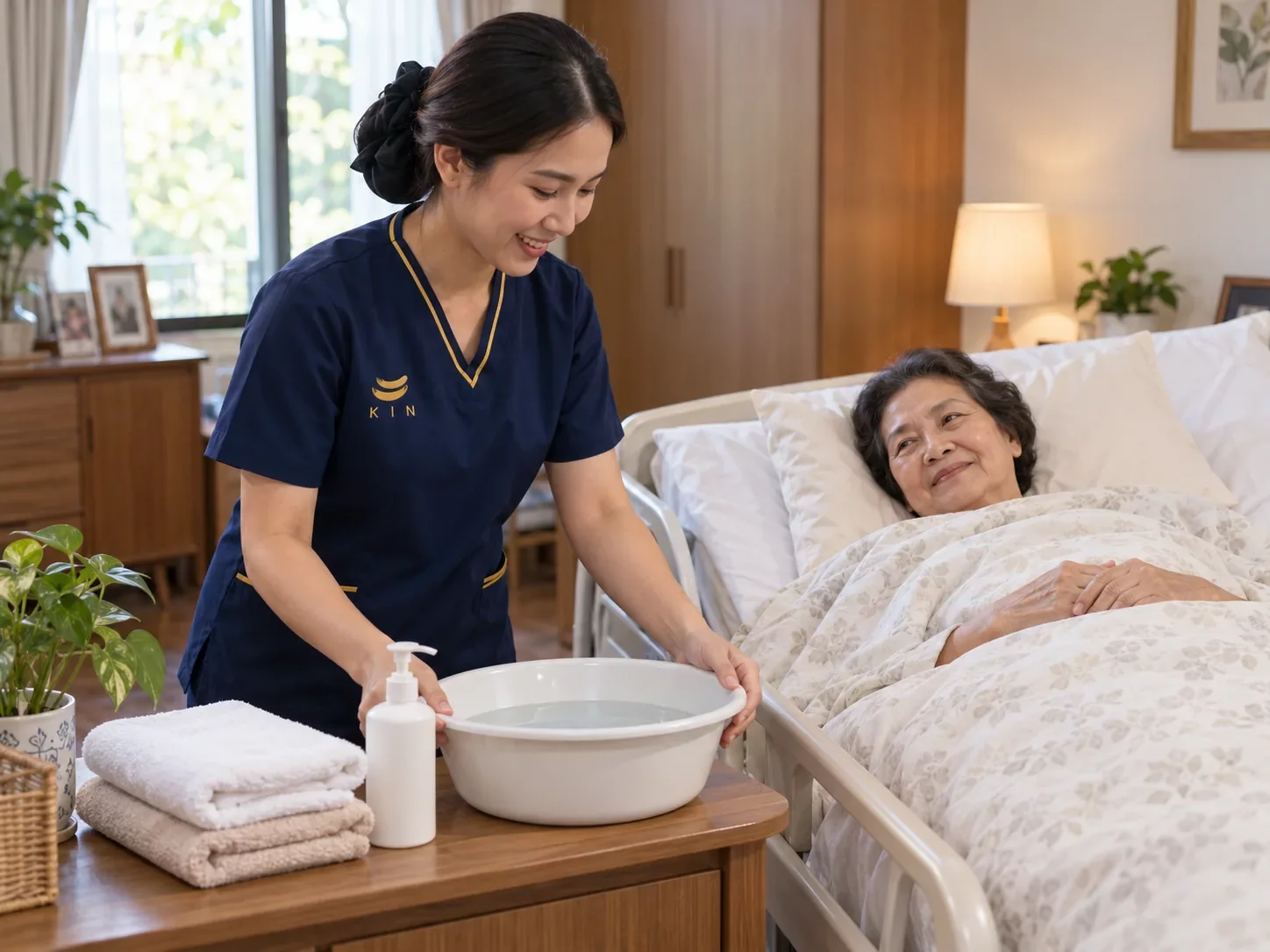
Make sure you have everything ready before you begin.
2. Step-by-step instructions for bathing a bedridden patient: Which part should you wipe first?
Short answer:Start from the face, work your way down to the feet, then turn sideways and wipe the back. Lastly, use fresh water and a new cloth to clean the intimate areas, wiping from front to back. Rinse off all soap and pat dry.
- 1. Inform the patient before starting.Wash your hands, put on gloves, and explain before moving or opening the cloth.
- 2. FaceUse lukewarm water or very little soap. Be careful not to get soap in the eyes. Have the patient wipe their eyes themselves if possible.
- 3. Neck, arms, hands, chest, abdomen.Open it section by section. Wipe, wash with soap, pat dry, apply lotion, and then cover it back up.
- 4. Legs and feetPlace a towel under the leg you are wiping and gently pat between your toes dry.
- 5. BackTurn the body onto its side, avoiding dragging it across the sheet as this can easily cause skin abrasions. Wipe the back, and check the skin of the tailbone and hips.
- 6. Hidden spotsChange the water and use fresh cloths. Always wipe from front to back. Diaper rash can occur. (Read more)Diaper rash in bedridden patients.
- 7. Close.Pat dry any creases, put on a diaper and clean clothes, and position the baby comfortably.
3. How to bathe a bedridden patient without them shivering and while maintaining their privacy.
Short answer:Close the doors, windows, and fans. Only uncover the area being wiped with the cloth. Complete the task in one go. Ask the patient how they would like assistance and allow them to do only what is safe for them to do.
The NHS notes that bathing is a very personal matter, and older adults are more susceptible to cold.
- Ask about preferences.Close the curtains, let outsiders out, and ask if anyone would be willing to help wipe your private parts.
- The patient is confused.Explain step by step. If there is resistance, stop and try again.
- Mouth and hair washingThis is another step. Follow the nurse's instructions. You don't have to do it all at once.

Open the cloth only for the part being wiped.
4. While wiping down a bedridden patient, observe any skin areas and report any redness to the nurse.
Short answer:Always inspect the skin over bony prominences such as the tailbone, hips, heels, elbows, and the skin under tubes or devices. Inform the nurse if any skin discoloration that doesn't fade when pressed, is unusually warm, elastic, hard, swollen, or cracked, and do not massage it.
| Points to watch | What did you notice? |
|---|---|
| Tailbone · Hip · Heel · Elbow | The skin is red or darkened, the color doesn't fade when pressed, and it feels warmer, more elastic, or harder than the surrounding area. |
| Underneath the bandage, plaster, or skin-attaching device. | Pressure marks, red marks along the lines. |
| Creases, groin, private parts | Moist, red, peeling, rash from urine or feces. |
Source: NHS Pressure ulcers · MSK Preventing Pressure Injuries · MedlinePlus
Do not rub or massage the red area on the bony prominence.Memorial Sloan Kettering patient documentation states that rubbing or massaging the reddened skin around the bony prominence can damage the underlying skin and tissue. Gently pat dry, inform the nurse, and reposition the patient as planned by the assessment team.Pressure sores: 5 things every family needs to know. · 3 ways to prevent pressure sores.
5. How can a patient with an NG tube or urinary catheter shower without the tube pulling on it or becoming dislodged?
Short answer:Adjust the catheter before turning the patient to prevent tension. Gently wipe around the catheter. Always keep the urine bag below the level of the bladder. If the catheter slips or becomes dislodged, do not push or reinsert it yourself. Insertion and removal of the catheter is the responsibility of the medical team; inform the nurse.
- NG lineDon't peel off the plaster yourself. Check for pressure marks on your nose.Tube insertion: Do not feed, water, or medication through the tube.Until the nurse examines you (CUH NHS).
- Urinary catheterKeep the bag below the level of the bladder and prevent the catheter from kinking (NHS). Wash around the catheter with mild soap and warm water. Pat dry. Do not use creams, powders, or sprays (MedlinePlus).
- Before turning over.Unhook the cord from the bed frame and position it in the same direction as you are lying on your side.

Adjust the straps before turning over every time.
6. When should you avoid bathing in bed or call a nurse?
Short answer:Postpone or cancel if the patient has a fever, chills, shortness of breath, severe pain, or refuses to respond. Notify the nurse if there is any skin or tube abnormality. If the patient has difficulty breathing or is unresponsive, call 1669.
- Wipe only the affected area instead.On days when you're not feeling well, just wipe your face, hands, and private parts.
- It hurts when I move.MedlinePlus recommends showering only after your prescribed pain medication has taken effect, and not adjusting your medication yourself.
- Inform the nurse within the day.Redness that doesn't fade when pressed, swollen, ruptured, smelly, urine leaking around the catheter.
- Notify the team immediately.No urine flow even though the catheter is not kinked and the bag is low (possibly a blockage), or fever and chills.
Call 1669 immediately.
• Difficulty breathing, shortness of breath, blue lips.
• Drowsiness, unresponsiveness, seizures, sudden confusion, or chest pain.
• No breathing or gasping for breath: Begin chest compressions and use an AED as directed by 1669.

"Bathing in bed is convenient; the patient doesn't feel cold or embarrassed, and every part of their skin can be examined."
How does KIN HomeCare help families care for bedridden patients at home?
KIN HomeCare, a home care service from KIN Rehabilitation, helps families care for bedridden patients on a daily basis.
- Home caregiver (caregiver)Bathing, turning, and diaper changing services are provided daily to monthly throughout the country (for provinces outside Bangkok, the Greater Bangkok area, Chonburi, and Pattaya, please contact us on a case-by-case basis). Specialized tasks are performed by trained caregivers under the supervision of a team of professional nurses.
- Registered nurse visits home.Follow the doctor's instructions regarding feeding tube, urinary catheter, and wound care. Instruct family members on how to continue care at home.
- Equipment rentalElectric adjustable hospital beds, pressure-distributing foam mattresses, and commode chairs: delivery, installation, and demonstration in Bangkok and surrounding areas.
Consult KIN HomeCare | Bathing and care for bedridden patients at home.
Home caregivers, home nursing visits, and equipment rental for bedridden patients.
KIN HomeCare
Home care services nationwide. Home-based physiotherapy available only in Bangkok and surrounding areas.


Home care · Nursing · Equipment rental061-881-9399
Home Physical Therapy095-767-6307
KIN Rehabilitation's Senior Rehabilitation and Care Center.
KIN Salaya
Buddhamonthon · Opening December 15, 2026 · Advance reservations are now available.
Central hotline:02-096-4996In case of emergency, call 1669.
Frequently Asked Questions answered by the KIN medical and multidisciplinary team.
How to bathe a bedridden patient in bed.
In a warm room with warm water (around 41 degrees Celsius), remove the towel section by section, starting from the front and working down to the feet. Turn the patient to the side and wipe their back, then change the water and wipe the genital area from front to back as the final step.
Wipe down a bedridden patient using warm or cold water.
Use warm water. MedlinePlus recommends around 41 degrees Celsius. If the patient is sensitive to heat, use a thermometer to measure the water temperature and always ask the patient if they are comfortable.
How often should bedridden patients bathe?
MedlinePlus states that showering in bed every day helps keep the skin clean and comfortable. On days when you feel unwell, you can simply wipe your face, hands, and intimate areas.
Is it okay to wipe down a patient who has pressure sores or bandages?
You can wipe other areas as usual. Be careful not to let the dressing get wet or come off. Do not rub around the wound. Follow the nurse's instructions for wound care. Inform the nurse if the dressing gets wet or the wound smells.
I noticed red marks on my tailbone while drying myself off. Should I massage them?
Do not rub or massage. Try pressing to see if the color fades. If it doesn't fade, feels warm, or is unusually hard, inform the nurse.
Can a patient with a urinary catheter take a shower?
Okay. Clean around the tube with mild soap and warm water. Pat dry. Do not pull on the tube. If the bag is below bladder level, or if the tube shifts or leaks, please inform the nurse.
- Bathing a patient in bed — MedlinePlus
- Indwelling catheter care — MedlinePlus
- Living with a urinary catheter — NHS
- How to look after my nasogastric tube — Cambridge University Hospitals NHS
- Scalding and burning — Health and Safety Executive (UK)
- Safer Bathing Procedure — NHS Lothian
- How to help someone you care for keep clean — NHS
- Pressure ulcers (pressure sores) — NHS
- Preventing Pressure Injuries — Memorial Sloan Kettering
Medical accuracy verified by Dr. Kamolchat Chokthanomsap, License No. 40854, Resident Physician | Supervised by Dr. Thongchai Chokthanomsap, Chairman of the Executive Board | Last updated: October 2026 |This article provides general information and is not specific medical advice. Patients with wounds, catheters, or mobility limitations should follow instructions from the medical team. Insertion and removal of catheters are the responsibility of the medical team.