

Facial asymmetry, paralysis (stroke), or Bell's palsy.
How to diagnose and when to go to the hospital immediately.
Go to the hospital first, differentiate the diagnosis later, because time is of the essence for stroke treatment.
Go to the hospital first, differentiate the illnesses later.
Framework for thrombolytic drug standards: Eligible candidates.
Treatment is most effective when started early.
AAO-HNS is recommended for all.
Waking up with a drooping corner of the mouth or an uneven smile often leads many to think of both paralysis and Bell's palsy.These two illnesses appear similar in the first hour, but their urgency differs greatly.
This article does not recommend any medications or dosages. Treatment is a matter for your doctor to decide.
 ▶︎▶︎ Tap to watch the 46-second clip.
The content in this article
1. Whether it's facial asymmetry, paralysis, or Bell's palsy, what should you do first when you encounter sudden facial asymmetry?
Short answer:Treat this as an emergency. Call 1669 or go to a hospital that treats strokes immediately. Note the time you first saw symptoms or the last time you were normal. Do not attempt to test yourself at home.
The European Standards Institute (ESO) guidelines (2021) recommend intravenous thrombolytic therapy for ischemic stroke.Within 4.5 hours of symptom onset.For those who meet the criteria, some who arrive late or wake up with symptoms may still be able to be treated based on brain scan results, but the sooner the better, the NHS emphasizes.Even though the symptoms disappeared on their own while waiting for the bus, I still had to go to the hospital for a checkup.Repeat the warning signal.BEFAST Stroke Warning Signal
Call 1669 immediately if you experience facial paralysis along with any of the following symptoms.
• Weakness or numbness in one side of the body (arm or leg).
• Speech difficulties, inability to speak, or difficulty understanding.
• Dizziness, blurred vision, or double vision.
• Sudden, severe headache, confusion, or drowsiness.
If you wake up experiencing symptoms, count from the last time you noticed you were normal. Read further.Stroke upon waking up
I'm not driving myself.Do not give any medication, food, or water until your doctor assesses your swallowing ability, and provide your doctor with a list of all medications you are currently taking.
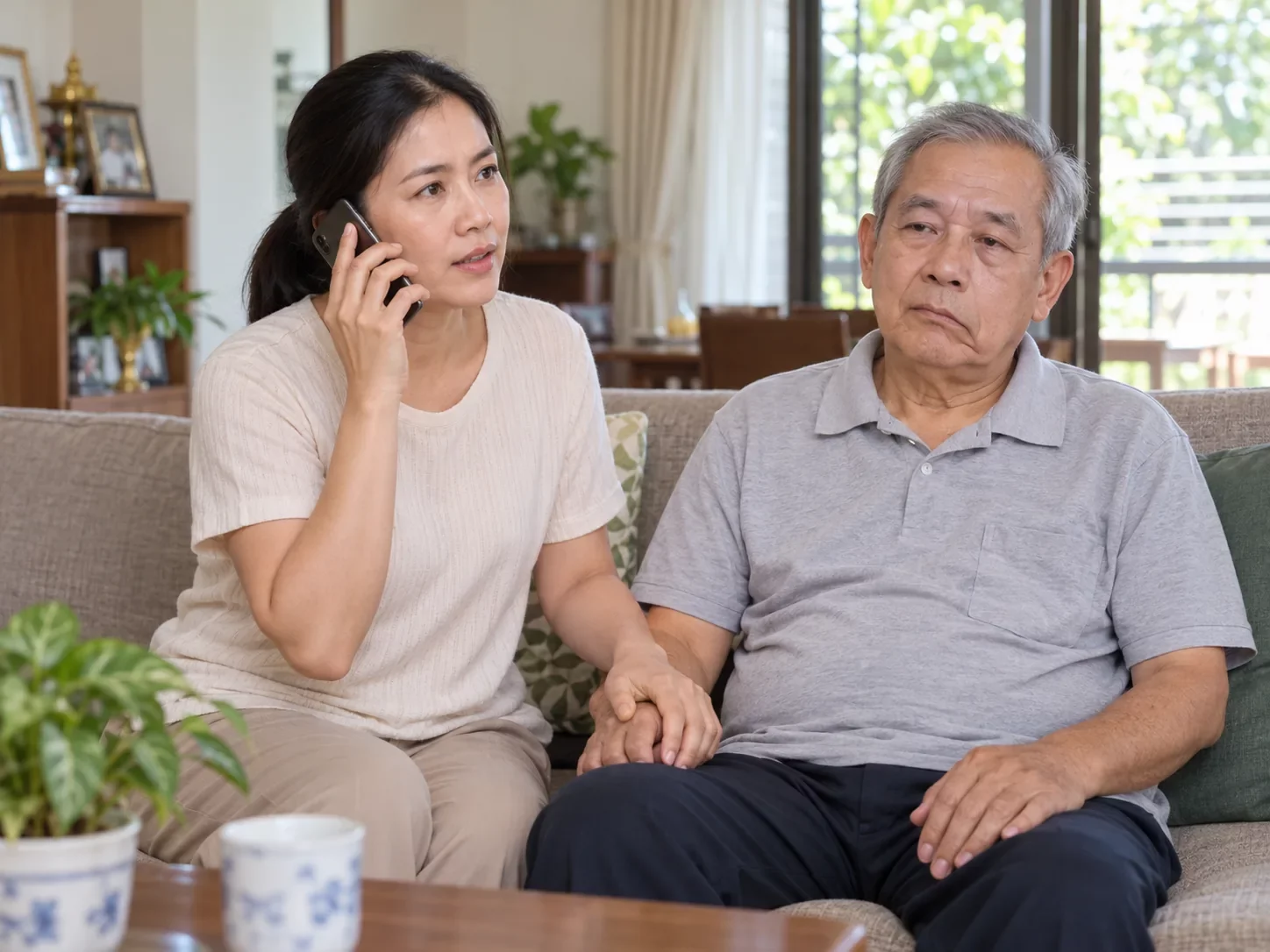
Call 1669 first, and note down the time the symptoms started.
2. What is Bell's palsy? How does it differ from paralysis?
Short answer:Bell's palsy is a rapid weakening of the peripheral facial nerve (cranial VII) without any other known cause. It is believed to be related to inflammation and swelling of the nerve. Facial paralysis from stroke, on the other hand, is caused by a lack of blood flow or bleeding to the brain.
The American Association of Otolaryngology-Hnose Surgery (AAO-HNS 2013) guidelines state that Bell's palsy is a common cause of hemifacial weakness, but...Facial weakness is not always a sign of Bell's palsy.Symptoms include inability to raise the affected eyebrow, inability to close the eye completely, drooping corner of the mouth, and in some people, decreased sense of taste or pain behind the ear (Faculty of Physical Therapy, Mahidol University).
3. Points doctors use to differentiate Bell's palsy from stroke: forehead, eye, and associated symptoms.
Short answer:Bell's palsy typically involves forehead wrinkling on the affected side and inability to close the eye completely. Stroke patients may also retain forehead wrinkling because the forehead receives signals from both hemispheres of the brain. Weakness in the limbs or slurred speech are also common, but these are clues for a doctor, not a deciding factor to make at home.
| nature | Bell's palsy (facial nerve) | Stroke (brain) paralysis |
|---|---|---|
| Forehead, raising eyebrows | The wrinkled side is not included. | It can still wrinkle. |
| Close your eyes. | It often doesn't close properly. | It can usually be closed. |
| Arms, legs, speech | normal | Often accompanied by weakness, numbness, slurred speech, or confusion. |
| Other symptoms | Reduced sense of taste, pain behind the ears. | Symptoms include unsteady gait, blurred vision, and severe headaches. |
| Doing what? | See a doctor within 72 hours. | Call 1669 immediately. |
Source: Faculty of Physical Therapy, Mahidol University · AAO-HNS · NHS · This is a physician's guide, not a self-diagnostic tool.

Raising your eyebrows is part of the examination.
4. Why is it forbidden to separate your hair at home, even if raising your eyebrows is allowed or not?
Short answer:Because some types of stroke can cause facial paralysis similar to Bell's palsy, and doctors need to rule out other causes such as shingles, ear infections, or tumors, raising the eyebrow cannot rule out any specific condition.
A study from California (Fahimi et al., 2014) that followed 43,979 patients presented to the emergency room with a diagnosis of Bell's palsy found that:0.8% were diagnosed with another condition within 90 days.Stroke is one of the primary causes, which may reflect some misdiagnosis (retrospective data). A review in the American Family Physician (2023) suggests looking for other causes when frontal weakness is not unilateral, is gradual, has decreased hearing, tinnitus, dizziness, or limb weakness.
Lessons from real cases.Four reported cases in the US (Lindor and Ghaith, 2025) involved stroke patients diagnosed with Bell's palsy. The authors warn that even with normal limbs, stroke cannot be ruled out in at-risk individuals.

"For the first time experiencing facial asymmetry, don't guess. Go to the hospital first, and then proceed with rehabilitation according to the doctor's diagnosis."
5. How to care for a Bell's palsy where the eye doesn't close completely, to prevent corneal ulcers.
Short answer:An eye that does not close completely will become dry and susceptible to injury. The AAO-HNS guidelines recommend protecting all eyes with incomplete eye closure by using artificial tears or eye ointment as prescribed by a doctor, and taping the eye shut while sleeping, as demonstrated by the team.
Do not self-medicate with eye drops.Have a nurse demonstrate how to apply the eye tape before doing it yourself (NHS).See a doctor early.If your eyes are red, painful, blurred, or sensitive to light.

Always protect eyes that are not completely closed.
6. How long does recovery take for Bell's palsy? Does facial physiotherapy help?
Short answer:The NHS states that symptoms usually improve within 6 months. Some people experience longer or have residual symptoms. If symptoms don't improve within 3 weeks or don't fully recover within 3 months, they should return to their doctor. Facial physiotherapy should begin after a doctor's diagnosis.
What does the facial physiology suggest?Cochrane (Teixeira et al., 2011) found insufficient evidence to support electrical stimulation. An updated review (Khan et al., Clin Rehabil, 2022) found new evidence supporting facial exercises, both in early and chronic cases, but the methods of exercise remain varied. See basic exercises at...Exercise for patients with facial paralysis.
How does Kin Hospital Sukhumvit 107 help after a doctor's diagnosis?
Kin Hospital, located on Sukhumvit 107 in Soi Bearing 10 near BTS Bearing, is registered as a physiotherapy hospital.This is not the emergency room.If you experience sudden facial paralysis, call 1669 first. Once a doctor diagnoses the problem, the team will assist in the rehabilitation process.
- Medical team of the departmentRehabilitation physicians and neurologists collaborate on appointment planning.Team list
- The rehabilitation medicine physician sees outpatients every Wednesday.Make an appointment via the branch's phone number or LINE.
- Outpatient physiotherapyandStroke recoveryRound trip, according to individual plans.
- Inquire about our services and visit the site for free any day.9:00 AM – 6:00 PM (excluding medical examinations)
Contact Kin Hospital Sukhumvit 107 | Free consultation and visit.
Rehabilitation after a doctor's diagnosis of Bell's palsy or stroke. For sudden symptoms, call 1669 first.
Other branches of KIN Rehabilitation
KIN Salaya
Buddhamonthon · Opening December 15, 2026 · Advance reservations are now available.


Central hotline:02-096-4996| Home-based physiotherapy 095-767-6307 | Care, nursing, and equipment rental 061-881-9399 | Emergency call 1669
Frequently Asked Questions answered by the KIN medical and multidisciplinary team.
If my face is distorted but I can still raise my eyebrows, does that mean I've had a stroke?
This is a clue that might lead doctors to suspect a brain-related cause, but they can't make a decision based on either alone. If you experience sudden facial paralysis, call 1669 immediately.
Only his face is distorted; his arms and legs are normal. Can we wait and see how he develops?
Don't wait. Some types of stroke have facial asymmetry as a more prominent symptom, and the sooner you treat a stroke, the more treatment options you have. It's safer to go to the hospital as soon as possible.
Within how many hours should a person with Bell's palsy see a doctor?
You should see a doctor within 72 hours of the onset of symptoms, as treatment is more effective when started early. The doctor will determine the medication and dosage; do not self-medicate.
My face was distorted but it went back to normal on its own in a few minutes. Do I still need to go to the hospital?
You need to go. It could be a transient ischemic attack (TIA), which warns of a risk of further stroke. The NHS states that even if the symptoms disappear while waiting for the train, you still need to be examined at a hospital. Call 1669.
Does Bell's palsy heal on its own? How long does it take?
Symptoms usually improve within 6 months. Some people experience longer or have residual symptoms. If symptoms don't improve within 3 weeks or you don't fully recover within 3 months, you should see your doctor again.
Do physical or electrical stimulation help Bell's palsy?
There isn't enough evidence to support regular electrical stimulation. However, there is increasing evidence supporting facial exercises. You should have a physical therapist evaluate you after your doctor's diagnosis.
- Clinical practice guideline: Bell's palsy — Baugh RF et al. (AAO-HNS) Otolaryngol Head Neck Surgery, 2013.
- European Stroke Organisation (ESO) guidelines on intravenous thrombolysis for acute ischemic stroke — Berge E et al., European Stroke Journal, 2021.
- Potential misdiagnoses of Bell's palsy in the emergency department — Fahimi J et al., Ann Emerg Med, 2014.
- Bell Palsy Mimics: Lessons from Four Malpractice Cases — Lindor R, Ghaith S Clin Pract Cases Emerg Med 2025
- Physical therapy for Bell's palsy (idiopathic facial paralysis) — Teixeira LJ et al., Cochrane, 2011.
- Physical therapy for facial nerve paralysis (Bell's palsy): An updated and extended systematic review — Khan AJ et al. Clin Rehabil 2022
- Bell Palsy: Rapid Evidence Review — Dalrymple SN et al., American Family Physician, 2023.
- Bell's palsy — NHS (Revised July 2023)
- Transient ischaemic attack (TIA) — NHS (Reviewed June 2023)
- Understanding Bell's Palsy — Physical Therapy Center, Faculty of Physical Therapy, Mahidol University.
Medical accuracy verified by Dr. Kritchatha Phungcharoen, License No. 40781, Neurologist | Supervised by Dr. Thongchai Chokthanomsap, Chairman of the Executive Board | Last updated: October 2026 |This article provides preliminary information; it is not a specific medical diagnosis or advice. It does not recommend any medications or dosages. For sudden facial paralysis, call 1669. Research figures are not based on results from patients who used KIN services.