

What preparations should be made for a bedridden patient returning home?
72-Hour Checklist: Which Equipment Should You Rent, Which Should You Buy?
Start preparing as soon as you know your return date.
Example: 72 → 48 → 24 hours.
Treatment summary · Medication · Appointment · Family training
Check the duration of use and symptoms.
Individuals with dependency issues in the system, October 2026.
Many families know their return home a few days in advance.What is often forgotten is the question to ask the hospital team before leaving.
General checklist; individual details should follow the treatment team's plan.
The content in this article
1. What preparations are needed when a bedridden patient returns home, and when should these preparations begin?
Short answer:Start as soon as the plan to return home is known. There is no fixed hourly schedule. The timeline in section 2 is an example. Prepare four things: information and training from the hospital, caregivers, a room, and equipment.
A 2022 Cochrane study totaling 33 studies and 12,242 patients found that individual discharge planning may slightly reduce hospital readmissions (RR 0.89, 95% CI 0.81–0.97; 17 studies and 5,126 patients; mean follow-up 3 months; moderate confidence evidence). The majority of studies involved patients with medical conditions, with an average age of 60–84 years. Read more.Guidelines for behavior after being discharged from the hospital and recovering at home.

Train them until the relatives can do it themselves before their departure.
2. Example timeline for preparing the home 72/48/24 hours before receiving a patient home.
Short answer:72 hours: Agree on caregiver arrangements and equipment delivery. 48 hours: Room preparation and training with a nurse. 24 hours: Equipment testing and receiving documentation and medication.
- 72 hoursAsk about the return date and necessary equipment. Agree on caregiver and backup shifts. Arrange for the delivery of beds, mattresses, and wheelchairs.
- 48 hoursPrepare the room; practice turning the baby over, transferring them to a wheelchair, and changing diapers until you can demonstrate it to the nurse; buy consumable supplies.
- 24 hoursTry adjusting the bed. Try pushing the wheelchair through the doorway. Get a summary of the treatment and medication regimen. Check it against the actual documents. Ask the team about the wheelchair and transfer procedures. Do not lift the patient manually if they cannot support their weight.
3. What do I need to request from the hospital before going home?
Short answer:We request four things: a treatment summary, a medication list specifying new medications, medications stopped or changed, appointment dates with the name and contact number of the person to call, and training for the family member to perform the necessary caregiving tasks.
- Treatment summaryDiseases, drug allergies, mobility restrictions, diet.
- List of medicationsNew medication, medication stopped or changed: Keep old medication at home separate. Do not adjust medication yourself.
- Appointment date and contact number.What symptoms require whom should you call?
- Training relativesPractice until you can do it. The caregiver must understand the instructions themselves. (MedlinePlus)
- Equipment and cablesWhich items require a doctor's prescription? Family members may refuse to insert or remove the tubing themselves.
4. How to arrange a room for a bedridden patient to make care easy and safe.
Short answer:Use the downstairs room near the bathroom. Place the bed so the caregiver can stand on both sides, keep the phone close at hand, tuck away carpets and power cords from hallways, and turn on the night light.
- roomDownstairs, near the bathroom, or with a commode chair in the room.
- bedLeave space on both sides to turn around. There is an electrical outlet nearby.
- Beside the bedTelephone, call button, drinking water within easy reach.
- bathroomHandrails and anti-slip mats are recommended; do not use towel racks as handrails.
If the doctor prescribes oxygen.No smoking in the room. Keep the device approximately 2 meters away from flames and heaters. Keep oil and alcohol away from the device. Do not apply Vaseline to your face or chest without asking the team first. Be careful not to trip over the cord. (MedlinePlus)
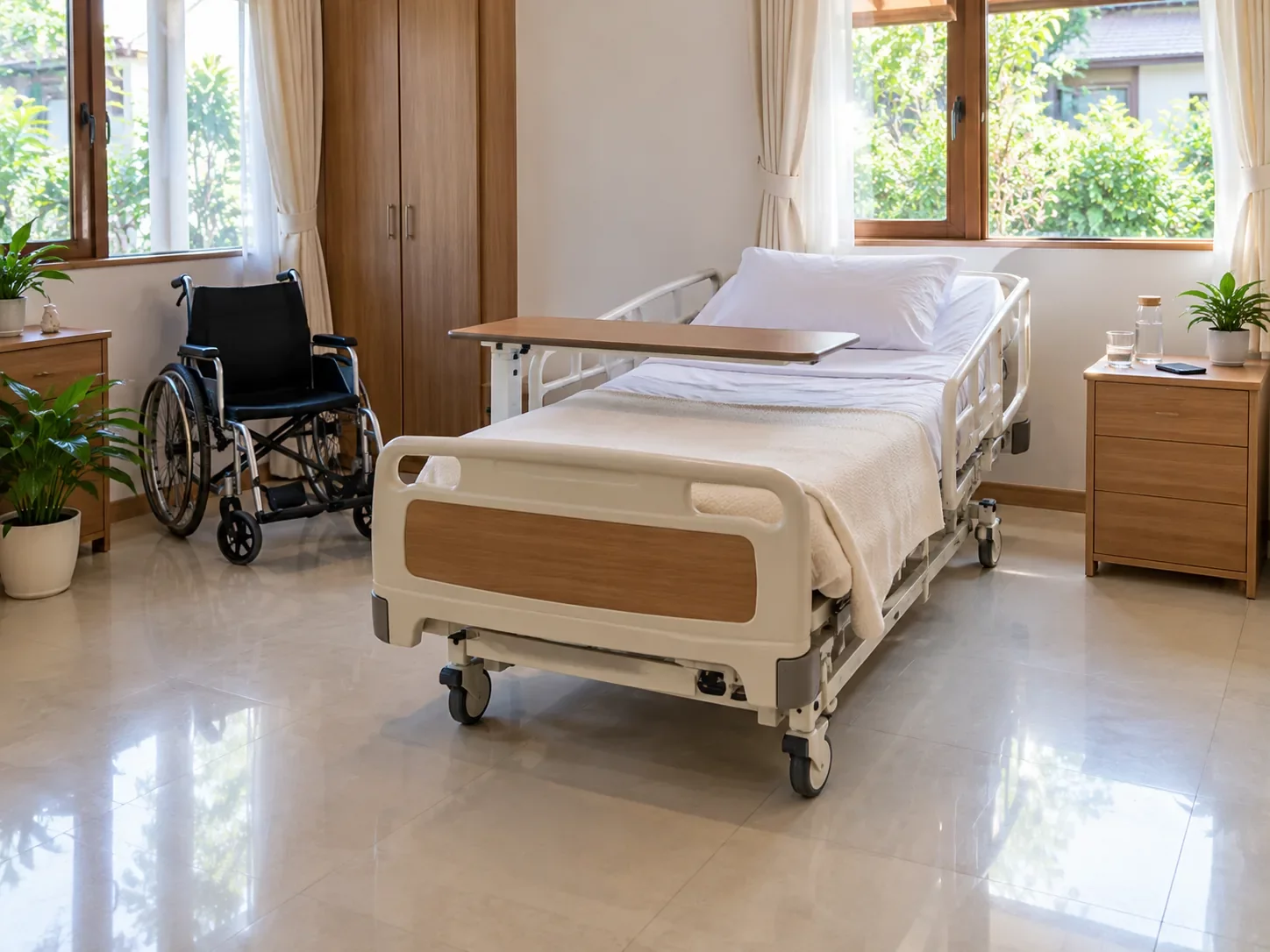
The bed is accessible from both sides, and the walkway is clear.
5. Checklist of equipment for bedridden patients: What should be rented, what should be purchased?
Short answer:There are no hard and fast rules for renting or buying; the decision depends on the healthcare team's recommendations, the patient's suitability, the expected usage period, the rental cost compared to the purchase price, maintenance, and replacement or repair services. Oxygen concentrators should only be used as prescribed by a doctor. Personal items and consumables, such as diapers and gloves, usually need to be purchased new.
| equipment | Rent or buy? Why? |
|---|---|
| Patient bed · Wheelchair | Consider renting or buying.High prices mean shifts in demand as the economy recovers. |
| Pressure sore prevention mattress | According to the nurse's assessment.The right type depends on each individual's risk factor. |
| Oxygen concentrator | Use as prescribed by your doctor, then consider renting or buying.If symptoms change, you may want to stop using it. |
| Commode chair · Overbed table | Rent or buyLet's see how long it lasts. |
| Diapers, absorbent pads, gloves, towels, mild soap, skin cream. | buyConsumable goods and personal items. |
General principle: For prescription equipment, always ask the medical team first.
A mattress doesn't replace turning over in bed.Cochrane (2021) found low confidence in the evidence that foam surfaces may cause more new pressure ulcers than alternating-pressure active-air and reactive-air surfaces. Comparisons with many other surface types are inconclusive. Mattresses are only one part of prevention; repositioning plans and frequencies must be determined by the nurse or care team based on risk, skin, positional tolerance, and the surface used.Choose a mattress that prevents pressure sores. · Electric or manual bed · Rent a bed and oxygen concentrator.
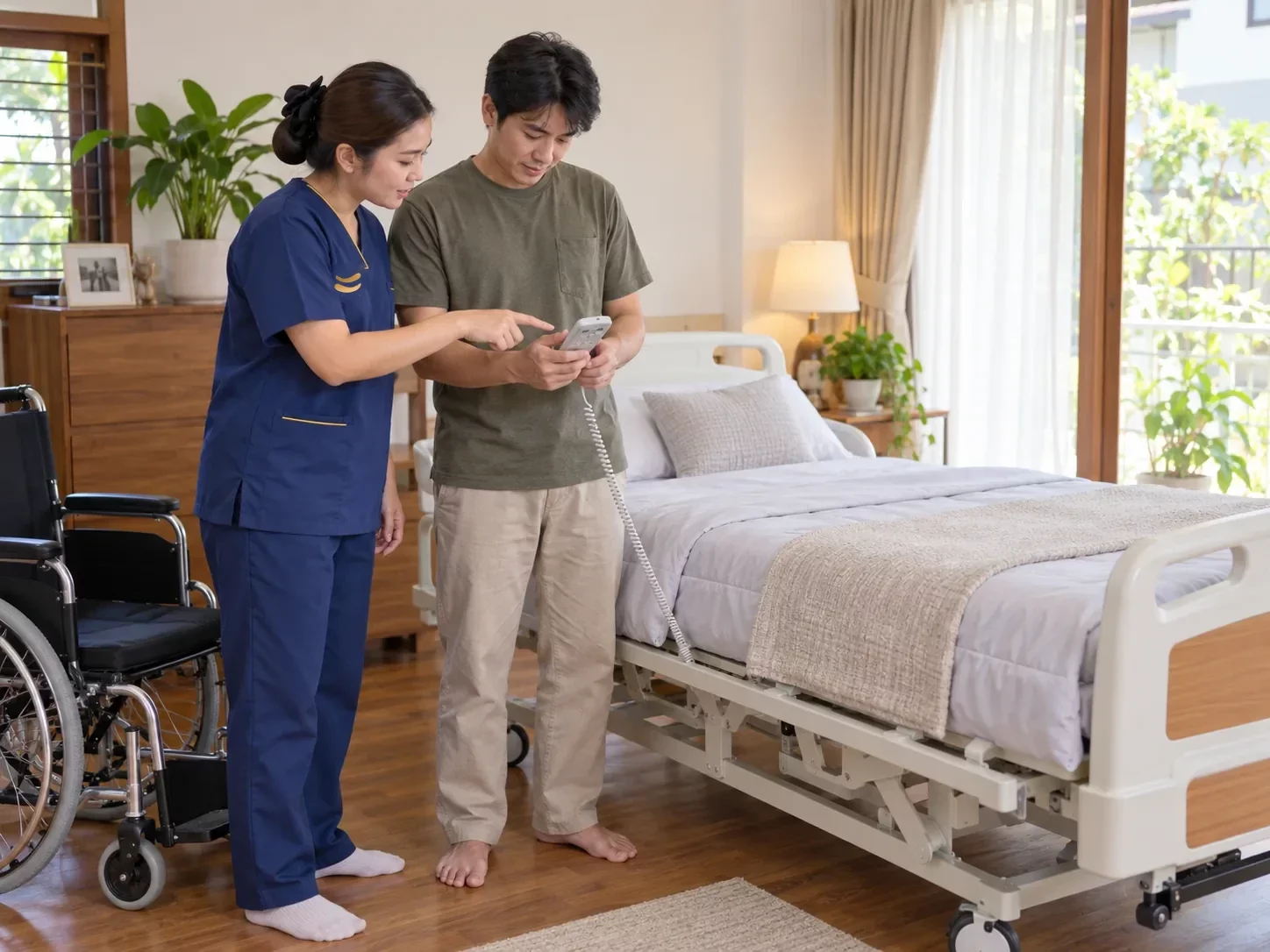
Practice until you're comfortable with it before you leave.
6. After returning home, who can help take care of me? What assistance does the government's LTC (Long-Term Care) system provide?
Short answer:The government's Long-Term Care (LTC) system employs caregivers and care managers in the community. Eligible dependents of all ages must be assessed and registered locally before being accepted.
A news report from the Department of Health on October 9, 2026, states that the Long Term Care system includes caregivers.135,591 peopleCaring for dependent individuals.560,461 peopleAccording to the NHSO document, Thai citizens of all ages and insurance coverages who achieve an ADL (Awareness of Daily Living) score of 11 or less are eligible for services from the Long-Term Care (LTC) fund. The assessment and registration are conducted by healthcare providers and local authorities.2027The Department of Health will expand its work, such as the 3C PLUS Super CG system and community health rehabilitation specialists.(General information as of October 2026. Please verify with the relevant agency before exercising your rights.)
Call 1669 immediately.
• Difficulty breathing, severe shortness of breath, blue lips.
• Lethargy, unresponsiveness, seizures, or chest pain.
• Sudden onset of facial asymmetry, weakness or slurred speech in one side of the body, or difficulty speaking.
• No breathing or gasping for breath: Begin chest compressions and use an AED as directed by 1669.
Notify the medical team within the day if you experience fever, decreased appetite, or redness around bony prominences.

"A good day home is when family knows which medications have changed and who to call if there are any problems."
How does KIN HomeCare help families who bring bedridden patients home?
KIN HomeCare, a home-based care service from KIN Rehabilitation, helps bridge the transition from hospital to home.
- Rent medical equipmentElectric hospital beds, pressure-distributing foam mattresses, wheelchairs, commode chairs, overbed tables, oxygen concentrators. Delivery within 24-48 hours. Installation, demonstration, cleaning and disinfection before delivery (Bangkok and surrounding areas).
- Home caregiverDaily to monthly rates, nationwide (for provinces outside Bangkok, the Greater Bangkok area, Chonburi, and Pattaya, please contact on a case-by-case basis). Specialized training is performed by trained caregivers under the supervision of a team of professional nurses.
- Registered nurse visits home.Provide care according to the doctor's plan and instruct the family.Home Physical TherapyFor Bangkok and surrounding areas only.
Consult KIN HomeCare | Transporting bedridden patients home.
Plan for caregivers and equipment before departure. Rent equipment, home nursing care, and home caregivers.
KIN HomeCare
Home care services nationwide. Home-based physiotherapy available only in Bangkok and surrounding areas.


Home care · Nursing · Equipment rental061-881-9399
Home Physical Therapy095-767-6307
KIN Rehabilitation's Senior Rehabilitation and Care Center.
KIN Salaya
Buddhamonthon · Opening December 15, 2026 · Advance reservations are now available.
Central hotline:02-096-4996In case of emergency, call 1669.
Frequently Asked Questions answered by the KIN medical and multidisciplinary team.
What preparations are needed to bring a bedridden patient home?
Prepare four things: information from the hospital, a caregiver, a downstairs room near the bathroom, and equipment. Start as soon as you know the plan for going home.
What questions should I ask the nurse before leaving the hospital?
Which medications are new? Should I stop or change them? Appointment date, contact number, symptoms requiring a follow-up visit, and please provide training until you can do it yourself.
Should you rent or buy equipment for bedridden patients?
There's no rule that says high-priced items must always be rented first. You should consider the medical team's recommendations, suitability, usage duration, rental costs compared to purchase price, maintenance, and repair services. Oxygen concentrators should only be used as prescribed by a doctor.
What type of vehicle should I use to transport a bedridden patient home?
Ask the medical team before the discharge date if the patient is suitable for transportation. If not, ask the hospital to recommend a vehicle with a stretcher. Use 1669 for emergencies.
Do I need an oxygen concentrator at home?
Use only as directed by a doctor. If using, do not smoke in the room and place the device approximately 2 meters away from open flames or heaters.
Can bedridden patients use the government's Long-Term Care (LTC) scheme?
According to the NHSO document, the NHSO's Long-Term Care (LTC) Fund Manual of 2024 specifies that all Thais of all ages who achieve a Barthel ADL score of no more than 11 are eligible for services. However, actual service provision requires prior assessment and registration by a healthcare provider or local authority.
- Department of Health moves forward with Long Term Care system — Department of Health, October 2026.
- LTC Fund: Management of the National Health Security System at the Local Level — NHSO 2024
- Discharge planning from hospital — Gonçalves-Bradley DC et al., Cochrane, 2022.
- Foam surfaces for preventing pressure ulcers — Shi C et al., Cochrane, 2021.
- Leaving the hospital – your discharge plan — MedlinePlus
- Getting your home ready – after the hospital — MedlinePlus
- Oxygen safety — MedlinePlus
Medical accuracy verified by Dr. Kamolchat Chokthanomsap, License No. 40854, Resident Physician | Supervised by Dr. Thongchai Chokthanomsap, Chairman of the Executive Board | Last updated: October 2026 |This article provides general information and is not specific medical advice. Medical devices and medications should be used as directed by the healthcare team. Long-term care (LTC) eligibility information is general as of October 2026. Please verify with your relevant agency before using your benefits.