

TMS After Stroke: What It Helps, Who It Suits, and Who Should Not Have It
Explained by a neurology physician, based on the latest guidelines and research
Average 0.51 points on the MAS (12 RCTs)
67% vs 65%, no different from sham
Post-stroke depression (2b)
Metal in the head · seizure history · pregnancy
Short answer: TMS (Transcranial Magnetic Stimulation) sends magnetic pulses through the skull to stimulate the brain area chosen by the physician, with no surgery and no anesthesia. In stroke patients, TMS is an add-on treatment used together with physiotherapy, not a replacement for training. The most consistent evidence so far is for reducing spasticity (but it has not been proven to improve hand use or daily activities). For arm and leg weakness and for walking, research results are still mixed, so the physician must select patients before every course.
This article provides general information. Each person's diagnosis and treatment must be assessed by a physician.
In this article
1. How TMS works
Short answer: One explanation is that after one side of the brain loses its blood supply, the two hemispheres may become unbalanced: the healthy side may become overactive and suppress the injured side. TMS programs based on this idea come in 2 forms:
- High-frequency stimulation of the injured hemisphere, to make it more active
- Low-frequency stimulation of the healthy hemisphere, to reduce its suppression
But this idea does not apply to everyone. In patients with extensive brain damage, the healthy hemisphere may be compensating, and reducing its activity may not help. The physician therefore chooses the type, location and intensity based on the type and location of the lesion, the severity and the remaining motor pathways, the time since the stroke, and the symptom to be treated. Two people with the same kind of stroke may receive different programs.
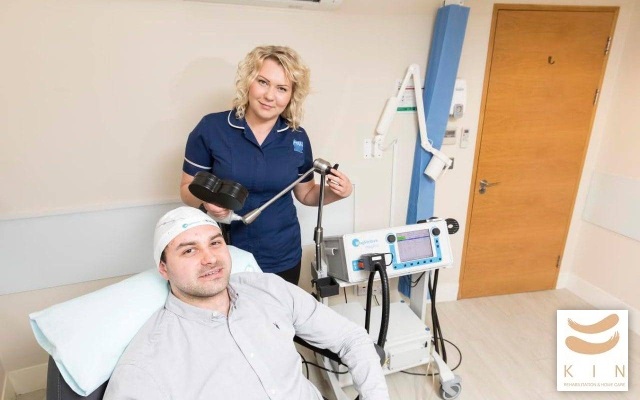
TMS is an add-on treatment, always combined with physical training
2. What the latest evidence says (by symptom)
| Symptom | Current evidence |
|---|---|
| Arm and leg spasticity | A pooled analysis of 12 randomized trials (Journal of Neurology, 2026) found that rTMS reduced spasticity scores (Modified Ashworth Scale) more than control groups by an average of 0.51 points · most studies were small · less spasticity may make it easier to stretch the arm, dress or clean, but it does not mean the hand will regain grasp. These studies did not measure daily living. |
| Arm weakness | Results are still mixed · In the US NICHE trial (199 patients, 3–12 months after stroke), both groups received equally intensive arm training and improved about equally (67% vs 65%), meaning TMS did not add to the effect of training · The E-FIT study (2023) pointed the same way. |
| Walking | In its supporting text (not a recommendation), the AHA/ASA 2026 guideline describes studies finding that high-frequency stimulation combined with gait training may help walking speed, but the evidence is still preliminary, and it notes that most brain stimulation devices are still investigational in the US. |
| Post-stroke depression | The only area where AHA/ASA 2026 makes a TMS recommendation (level "may be considered" · 2b) |
| Memory, speech | Still at the research stage; not yet recommended by guidelines |
What NICHE tells us most clearly is not that TMS has no benefit, but that intensive, goal-directed training is the core of recovery. Research still cannot say clearly which patients gain extra benefit from TMS. Even after physician selection, results vary greatly between individuals, and no machine can replace training.
3. Who a physician may consider
Short answer: A physician will consider TMS when the patient
- has a symptom supported by evidence, such as arm or leg spasticity that interferes with training
- can do physiotherapy regularly, because TMS must be paired with training
- is physically stable and not in an acute illness
- has passed safety screening
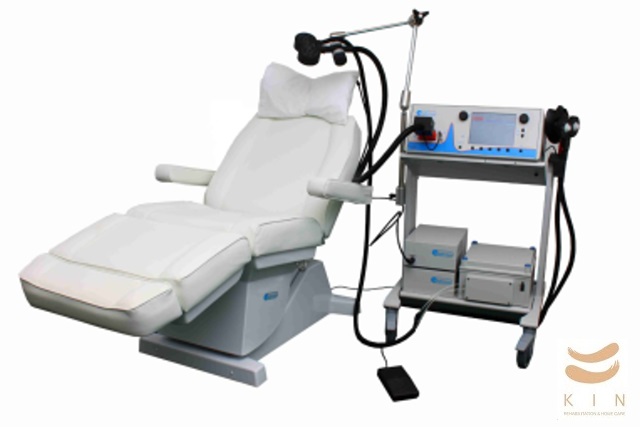
The patient stays awake throughout, about 20–30 minutes per session
4. Who should not have it, or needs special review by a physician
- Metal in the head, such as certain brain aneurysm clips or metal fragments near the head
- Implanted devices, such as a pacemaker, cochlear implant or brain stimulator
- History of seizures, or taking medicines that lower the seizure threshold
- Pregnancy
- Health problems that are not yet stable
Seizures from TMS are rare, but they are the main reason a physician must screen before starting, and TMS should not be done where there is no physician supervision.

Before starting, screening covers metal in the head, seizure history and current medicines
5. What one TMS session is like
- The physician assesses the history, brain imaging and current medicines
- The target location and intensity are measured for each person's brain
- Stimulation lasts about 20–30 minutes. The patient sits awake throughout and feels something like tapping on the head; some people's facial or jaw muscles twitch in rhythm, or they feel discomfort at the stimulation site
- Physiotherapy or occupational therapy follows, to use the period when the brain is more responsive
- Results are re-measured regularly; if there is no improvement toward the goal, the physician adjusts or stops rather than continuing indefinitely
The machine makes loud rhythmic clicks, so patients wear earplugs during every session. Common side effects are mild headache or scalp tightness, which usually settle the same day.

TMS works best when followed immediately by real training
TMS at KIN • Available at KIN Sukhumvit 107 and KIN Ladprao 71
• Every patient is assessed by a physician first; if the physician finds it not yet suitable, other training will be offered instead
• Combined with physiotherapy, occupational therapy or speech therapy according to each person's goals
• TMS fee 3,500 baht per session · package prices and what is included are explained in full by staff before starting
Read more: KIN's 5-stage stroke rehabilitation system · Spasticity after stroke
Consult a Physician | KIN Sukhumvit 107
Book a physician consultation in advance (not for emergencies) · Having stroke symptoms now? Call 1669


Other KIN Rehabilitation locations
Central Hotline: 02-096-4996 | Home physiotherapy 095-767-6307 | Care, nursing and equipment rental 061-881-9399 | Emergency: call 1669
Frequently Asked Questions – Answered by KIN's Medical and Multidisciplinary Team
Does TMS hurt?
No surgery and no injections. Most people feel something like tapping on the head; some feel discomfort or facial muscle twitching during the session and a mild headache afterwards. If it is too uncomfortable, tell the team so they can adjust or stop.
How many sessions are needed?
It depends on the symptoms and the response. The physician sets goals and schedules re-assessment; there is no number of sessions that suits everyone.
I had my stroke years ago. Can I still have it?
Some people can. Several studies included patients in the chronic phase, but the longer it has been, the slower recovery tends to be and the more specific the goal must be, such as reducing spasticity to make care easier. The physician must assess individually whether the goal is achievable.
If I have TMS, can I skip physiotherapy?
No. The effect of TMS depends on the training done with it.
Does TMS help post-stroke depression?
There is evidence that it may help reduce depressive symptoms, but the condition must be diagnosed first, and medication or psychological care may also be needed.
- Richards LG, et al. 2026 Guideline for Adult Stroke Rehabilitation and Recovery. Stroke. 2026;57(10):e514–e658
- Harvey RL, et al. Randomized Sham-Controlled Trial of Navigated Repetitive Transcranial Magnetic Stimulation for Motor Recovery in Stroke (NICHE). Stroke. 2018;49(9):2138–2146
- Electric Field Navigated 1-Hz rTMS for Poststroke Motor Recovery: The E-FIT Trial. Stroke. 2023;54(9):2254–2264
- Systematic review and meta-analysis of the efficacy of repetitive transcranial magnetic stimulation on post-stroke limb spasticity. J Neurol. 2026

Written and medically reviewed by Dr. Krichtha Phuengcharoen (License No. 40781), Neurology Physician | Supervised by Dr. Thongchai Chokthanomsap, Chairman of the Executive Board | Last updated: November 2026 | General health information, not individual medical advice. Main medicines and follow-up appointments remain with your own hospital physician.