

Can stroke be cured?
What percentage recover? A summary of the real chances of recovery
The question families fear most is “Will Dad walk again? Will Mum be able to speak again?” This article answers with figures from research whose sources have been checked, and explains which figures apply to whom, and to whom they do not apply.
Some remaining symptoms are common
Only among participants in the AVERT trial
An estimate from data on 6,259 patients in Japan
Results vary from person to person
If new symptoms appear suddenly, do not wait and see Facial drooping, weakness or numbness in an arm or leg, slurred speech, abnormal vision, unsteady walking, or a sudden severe headache: note the time the symptoms started and call 1669 (Thailand's emergency medical line) right away, even if the symptoms go away on their own.
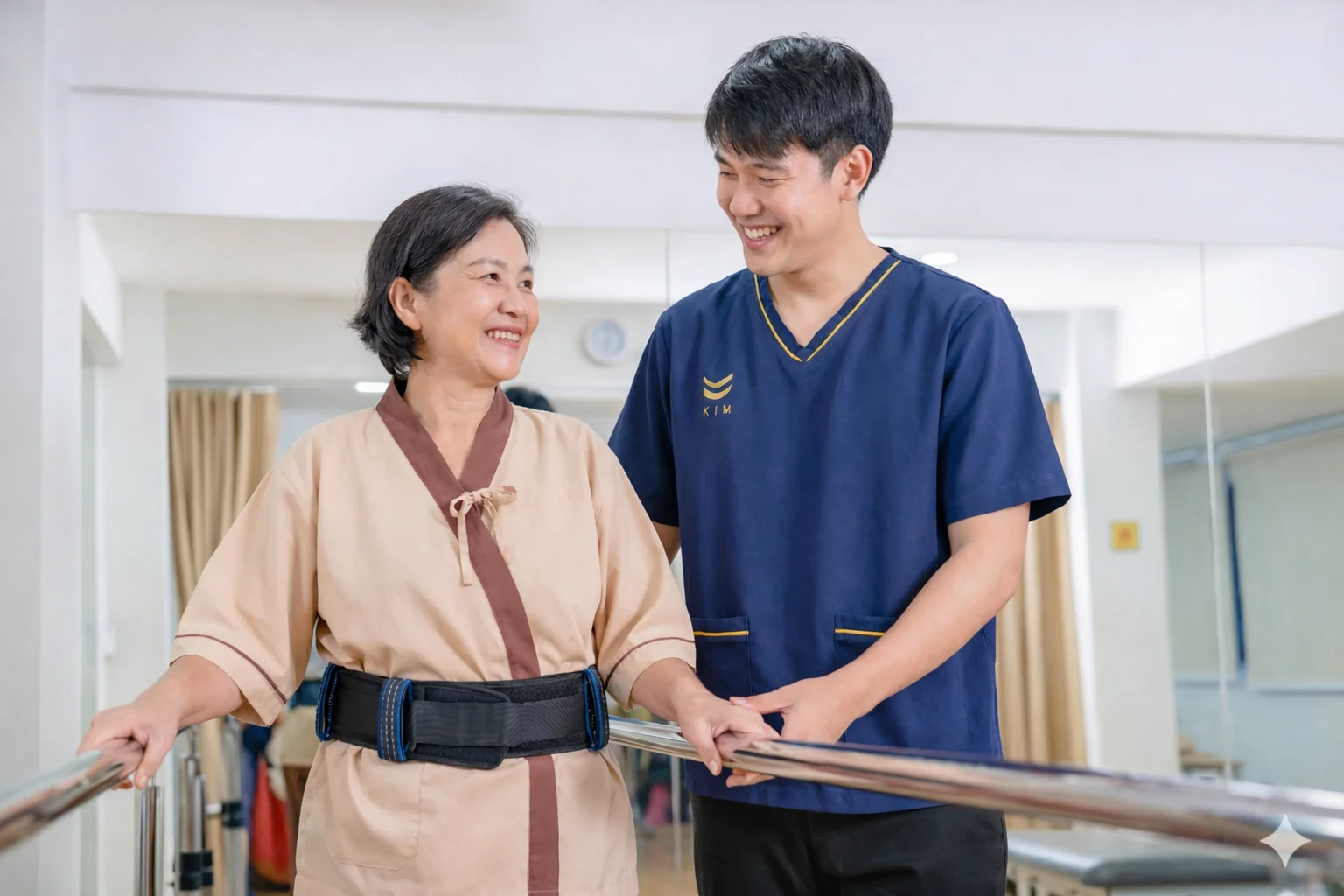
For many families, the first goal is walking again
In this article
1. Can stroke be cured? What does “cured” mean?
Short answer: If “cured” means going back to exactly how things were before, most patients do not get there. But many patients become able to look after themselves again, even with some remaining symptoms, and rehabilitation that fits each person's pace helps support recovery.
Research commonly measures outcomes with the mRS (modified Rankin Scale), and mRS 0–2 is considered a good outcome. But mRS 0–2 does not mean a return to normal, and it cannot directly tell you how well a person will walk, speak, use their hands or swallow. That is why the team has to assess each area separately.
| mRS | Meaning |
|---|---|
| 0 | No remaining symptoms |
| 1 | Some remaining symptoms, but able to carry out all usual activities and work |
| 2 | Unable to do some previous activities, but able to look after own affairs without help |
| 3 | Needs help with some things, but can still walk independently |
| 4 | Cannot walk independently and cannot attend to own bodily needs |
| 5 | Bedbound, needs care at all times |
| 6 | Death |
2. What percentage recover? Figures from research with checked sources
Short answer: There is no single figure for everyone. The figures that can be cited come from patient groups that met each study's criteria, and they differ in patient group, starting point and time of measurement, so the percentages cannot be compared across rows. They are not figures for KIN patients and cannot be used to predict individual outcomes.
| Study | Patients | Measured at | Finding (mRS 0–2) |
|---|---|---|---|
| AVERT · The Lancet 2015 · Randomised trial | 2,104 patients in stroke units in 5 countries, excluding those who were unstable or had significant disability before the stroke | 3 months | 50% in the usual-care group · 46% in the group mobilised frequently and intensively from the first 24 hours |
| Frontiers in Public Health 2026 · Single-hospital retrospective study | 177 patients aged 60 and over with ischemic stroke | Day of hospital discharge | 54.9% in the multicomponent early mobilization program group, vs 34.9% |
| JAMDA 2026 · Observational data, Japan | 6,259 patients with ischemic stroke transferred to rehabilitation wards | 60 days | Training an average of 2 hours or more per day in the first month: about 15 percentage points higher (an estimate from a statistical model) |
Figures taken from the abstracts · The limitations of each study are listed in the reference box at the end of the article
Reading the figures correctly “15 percentage points” is a comparison between groups; it does not mean that any individual patient will improve by 15%. · As for AVERT, it found that the group mobilised frequently and intensively from the first 24 hours had fewer good outcomes than the usual-care group, but this does not mean patients should lie still. The type and amount of activity must be set by the treating team according to how stable each person is. Read about the amount of training in How many hours of physical therapy a day should stroke patients do? (Thai)
.webp "A physical therapist helps an older patient practise making a fist and lifting the wrist, KIN Rehabilitation center")
Each area is assessed and trained separately, such as hand use
3. What helps recovery, and what slows it down
Short answer: The severity of the stroke and the person's abilities before it have a big effect. What families can help with is starting rehabilitation when the treating team judges it safe, training regularly according to plan, preventing complications, and preventing another stroke.
What supports recovery
For how long rehabilitation takes at each stage, read How many months does stroke rehabilitation take?, and for checking vascular causes, see the KIN Charnn Vascular Center
4. Ischemic vs hemorrhagic stroke: are the chances of recovery different?
Short answer: Hemorrhagic stroke (bleeding in the brain) is, on average, more severe in the early phase, and some patients need surgery, but those who get through the critical period can still be rehabilitated. The assessment is therefore based on severity, age, the size and location of the lesion, and complications, not on the type alone.
Read specifically about hemorrhagic stroke in Brain hemorrhage: can it be cured? (Thai). Two of the three studies in the table above looked only at ischemic stroke, so take care when applying them to hemorrhagic stroke.
.webp "A physical therapist explains the rehabilitation plan to an older patient and their daughter, KIN Rehabilitation center")
The team explains achievable goals so that the patient and family share the same understanding
5. Severe cases, bedbound, or a long time since the stroke: is there still a chance?
Short answer: It is too early to conclude there is no hope, but goals need to be realistic. For some patients the goal is to walk again; for others it is to do more for themselves, reduce complications and be easier to care for.
People who have had a stroke for many years A 2026 study from Scotland of patients who had had their stroke for an average of almost three and a half years (59 of 67 completed the training), most of whom could still walk to some degree, used 8 weeks of group training combining several types of technology. It found that walking and sit-to-stand improved to a clinically meaningful level, and grip strength improved to near that level. It was a single-group pilot study, so it cannot answer questions about bedbound patients. Meanwhile, a 2026 review in the journal Stroke concluded that training in the chronic phase may, on average, need a higher dose than in the early period, and that there is still no single formula that works for everyone.
- Long time since the stroke: Can you still recover from a stroke you had a long time ago?
- Severe symptoms: Can severe stroke cases still recover? (Thai)
- Bedbound: Bedbound after a stroke: can they still walk again?
6. Supporting recovery appropriately and safely
Short answer: Have a rehabilitation medicine doctor assess the patient from the early phase, set goals for each area separately, train with a team that includes physical therapy, occupational therapy and speech and swallowing therapy, follow up on progress regularly, and manage prevention of another stroke at the same time.
Research and KIN's services are separate matters All the research on this page studied other care systems and other patient groups. It did not test KIN's programs and does not guarantee individual results.
At KIN, doctors from 3 main specialties – rehabilitation medicine, stroke medicine and geriatric medicine – visit patients every week. They are part of a medical team covering 5 specialties (see the list) and work together with a multidisciplinary team from 8 professions. For program details and prices, see the Stroke Rehabilitation Program
.webp "A physical therapist trains an older patient to walk on an underwater treadmill, KIN Rehabilitation center")
Walking in water helps support body weight. It is an add-on tool that the doctor considers based on each patient's condition

“We do not promise that patients will recover to exactly how they were before. The team assesses progress and regularly tells the family where things stand compared with the goals. In some periods there may be no visible change yet, and sometimes we need to adjust the goals together.”
Contact us | Free consultation and visits
Consultations and center visits are available every day, 09:00–18:00, free of charge · First doctor's assessment THB 1,000
KIN Medical Hub Lat Phrao 71


KIN Physical Therapy Hospital Sukhumvit 107
KIN Rehabilitation Center Pattaya
KIN Rehabilitation Center Ratchaphruek
KIN Ramkhamhaeng 24 – reserve a place before it opens on 15 November 2026
KIN Salaya – reserve a place before it opens on 15 December 2026
Central hotline: 02-096-4996 | Home physical therapy 095-767-6307 | Care, nursing and equipment rental 061-881-9399 | In an emergency, call 1669
Frequently asked questions, answered by KIN's medical and multidisciplinary team
Can stroke be completely cured?
Most patients do not return to exactly how they were before the stroke, but many are able to look after themselves again, even with some remaining symptoms. Rehabilitation that starts once it is safe, with regular training according to plan, helps support recovery.
What percentage of stroke patients recover?
There is no single figure for everyone. Among participants in the AVERT trial, 46–50% had a good outcome (mRS 0–2) at 3 months. This figure is not the rate for all stroke patients and cannot be used to predict an individual's outcome.
Will weakness or slurred speech go away?
They often improve with regular training. Some people improve a lot, while others still have some remaining symptoms. The physical therapy team and speech therapists assess each area separately and set goals suited to each person.
Ischemic or hemorrhagic stroke: which is easier to recover from?
Hemorrhagic stroke is, on average, more severe in the early phase, but those who get through the critical period can still be rehabilitated. It depends on severity, age, and the size and location of the lesion; the type alone does not decide it.
It has been several years. Is there still a chance of improvement?
Yes, there is. A 2026 study of patients who had had their stroke an average of almost three and a half years earlier found that walking and sit-to-stand improved after 8 weeks of training. However, it was a pilot study with no comparison group, and results vary from person to person.
How many months does rehabilitation take?
It varies from person to person. The clearest changes are usually seen in the first 3–6 months. Read the details of each stage in our article How many months does stroke rehabilitation take?
- Efficacy and safety of very early mobilisation within 24 h of stroke onset (AVERT) — The Lancet 2015 · Conducted in acute stroke wards; excluded unstable patients; start time and amount were changed together
- Effects of evidence-based early mobilization on prognostic outcomes in older patients with acute ischemic stroke — Frontiers in Public Health 2026 · Single-hospital retrospective study, measured at hospital discharge
- Heterogeneity in the Effectiveness of Rehabilitation Dose on Activities of Daily Living in Post-Acute Stroke — JAMDA 2026 · Observational data from Japan
- Update on Rehabilitation After Stroke: Global Changes and the Continued Importance of Therapy Intensity, Dose, and Timing — Stroke 2026 · Review article
- Intensive, Multi-Technology Rehabilitation Programme for Chronic Stroke Survivors — Physiotherapy Research International 2026 · Single-group pilot; most participants could still walk
Medically reviewed by Dr. Kamolchat Chokthanomsap (Thai Medical Council licence 40854), KIN staff physician | Overseen by Dr. Thongchai Chokthanomsap, Executive Chairman | Last updated: 26 September 2026 | General information, not individual medical advice. Research figures are results for patients in the studies, not outcomes of KIN patients.