

How Many Months Does Stroke Rehabilitation Take?
Recovery Time for Each Phase of Stroke
The first question most families ask is how long it will take. This article answers with the time framework that researchers around the world share, together with the latest research.
Most patients are still in hospital
Usually the period of most visible change
Progress is still possible, but needs more training
Depends on severity and training
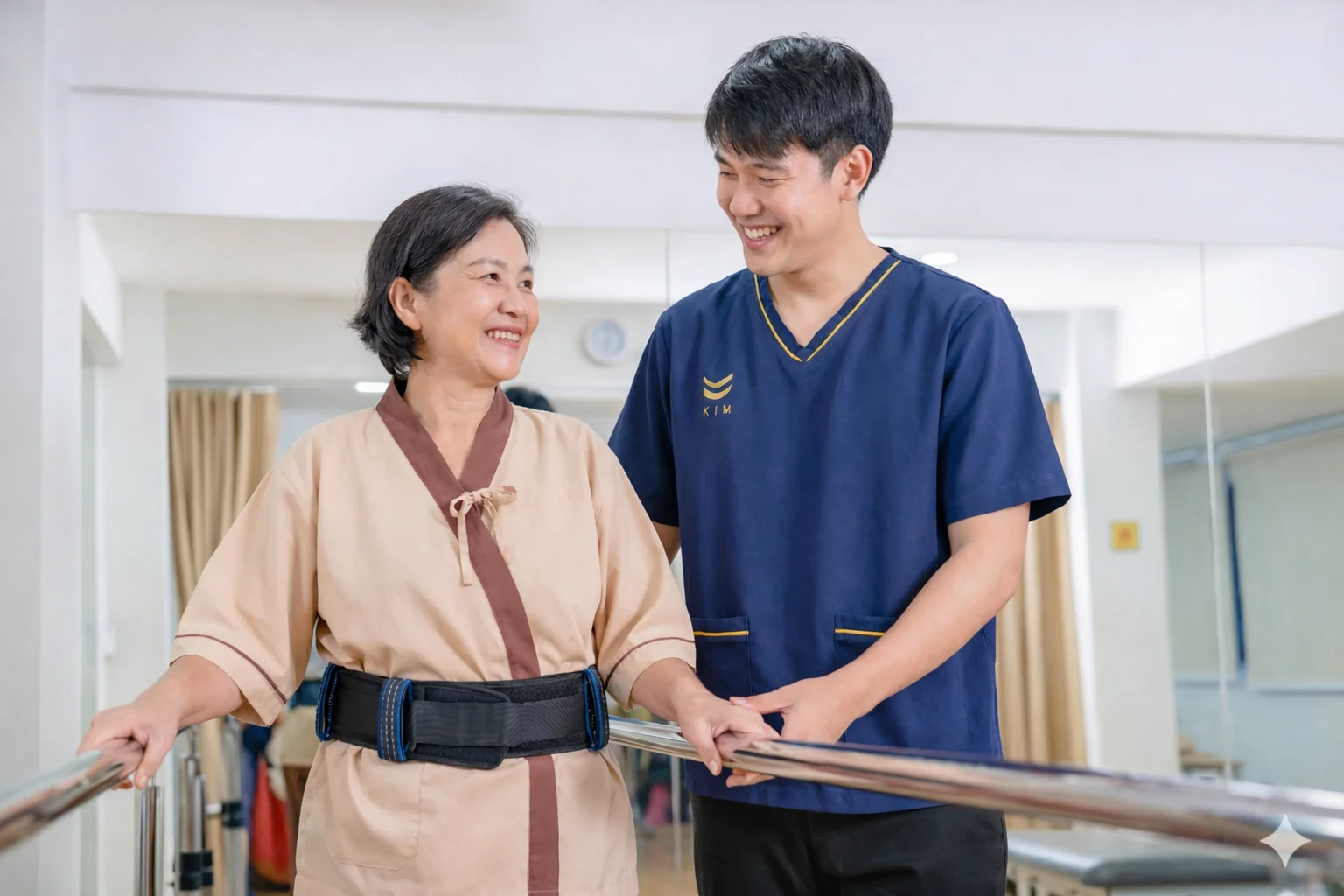
Walking practice at the parallel bars under the supervision of a physical therapist
In this article
1. How many months does stroke rehabilitation take — a short answer for families
Short answer: There is no single number that applies to everyone. The first 3–6 months usually show the most visible change, so the patient should be assessed and start a rehabilitation plan once the condition is stable. After that, progress is still possible, but on average more training is needed and there is no formula that guarantees results.
A 2026 review article in the journal Stroke concluded that the amount of training still matters, but there is not yet one best number for everyone, and if training starts in the chronic phase, much more training is needed to get results close to those of training in the early period. So the question to ask is “Which phase are we in now, and what should be trained in this phase?”
Do not wait until the patient is strong before starting training Long bed rest leads to muscle weakness, joint stiffness and a risk of pressure sores. Once the doctor assesses that the condition is stable, continuous rehabilitation should begin. Read How soon after a stroke should physical therapy start
The Golden Period is not a deadline It means the first 3–6 months, when training should be stepped up; it does not mean that the chance is gone once it has passed. It is also different from the Golden Time (the first hours), when the patient must get to hospital quickly (drooping mouth, weakness in an arm or leg, slurred speech, sudden unsteady walking, blurred vision, severe headache — note the time symptoms started and call 1669). Read The Golden Period in stroke recovery
2. The 3 phases of stroke — how long each lasts and what to do in each phase
Short answer: The time framework of the international research working group (SRRR) has 5 periods: 0–24 hours · 1–7 days · 7 days to 3 months · 3–6 months · beyond 6 months. This article shortens them into 3 phases that are easy to remember: acute (first 7 days), rehabilitation (7 days to 6 months) and ongoing (beyond 6 months).
These definitions come from the Stroke Recovery and Rehabilitation Roundtable working group (International Journal of Stroke, 2017). They are used so that research speaks a common language; they do not predict how much any individual will recover, and the studies cited on this page did not evaluate KIN's services.
| Phase (approximate) | What the team focuses on | What the family does |
|---|---|---|
| 1. Acute First 7 days, mostly in hospital | Stabilise the condition, find the cause, position the patient, prevent pressure sores, joint stiffness and aspiration pneumonia, and start moving when ready | Do not give water, food or medicine by mouth until a swallowing assessment has been passed Ask about the plan after discharge from hospital |
| 2. Rehabilitation, early stage Week 2 – month 3 | The period when progress is usually most visible: practise getting up to sit, standing, walking, using the hands, speaking and swallowing, repeated many times a day | Choose a place for training quickly and track progress week by week |
| 2. Rehabilitation, late stage Months 3–6 | Can still improve, but some areas slow down: practise real daily routines — dressing, eating, using the toilet, walking around the house | Prepare the home, train the caregiver, plan the return home |
| 3. Ongoing (chronic) Beyond 6 months | Maintain the abilities gained, train the skills still lacking, and prevent a recurrence | Keep training without stopping, because abilities can decline once training stops |
The whole of phase 2 (roughly the first 6 months) is the period known in Thailand as the Golden Period · Each patient recovers at a different pace
Start early, but earlier and harder is not always better A single-hospital retrospective study (Frontiers in Public Health, 2026) found that early mobilisation with safety criteria, split into several sessions a day, was associated with less pneumonia and fewer blood clots. However, the AVERT randomised trial (The Lancet, 2015) found that the group that got up to train frequently and intensively from the first 24 hours had fewer good recoveries at 3 months than the usual-care group (46% vs 50%). So training starts when the doctor assesses the patient as ready. Data from 6,259 patients in Japan (JAMDA, 2026) found that training an average of 2 hours or more a day in the first month was associated with regaining more independence. Read more: How many hours a day should a stroke patient do physical therapy (Thai)
More than 6 months or even a year after the stroke, training is still possible A 2026 study from Scotland in patients who had had their stroke for an average of almost three and a half years (59 of 67 completed the training) used group training combining several types of technology, 2 hours per session, an average of 2.3 sessions a week for 8 weeks. Walking and sit-to-stand improved to a level patients could notice, and grip strength improved to close to that level, but it was a pilot study with no comparison group. Read Can you recover from a stroke that happened long ago? · Can severe cases recover? (Thai) · Can a bedridden patient walk again? · Can stroke be cured?
3. Factors that make recovery faster or slower — which ones the family can control
Short answer: Severity, location, type of stroke and age cannot be controlled, but when training starts, how consistent it is, control of other health conditions and support from the family can all be worked on from today.
- Cannot be controlled: The severity and location of the brain injury, the type of stroke (blocked or burst vessel; read Brain haemorrhage: can it be cured? (Thai)), age, and abilities before the illness (data from Japan found that the benefit of training differed by age, sex and ability at the start, but older people can still train)
- Can be controlled: Start when the doctor assesses the patient as ready, train every day with clear goals, control blood pressure, diabetes and cholesterol, take medicine as prescribed without stopping on your own, stop smoking, look after depression, and have the family help keep training going — while the caregiver also needs rest
.webp "A physical therapist explains the rehabilitation plan to an elderly patient and her daughter at a KIN Rehabilitation center")
Explaining the plan and goals so the family shares the same understanding
4. Rehabilitation at a center or at home — choose according to the phase and symptoms
Short answer: If the condition is not yet stable, the doctor must first decide whether the patient still needs to stay in hospital. Once the condition is stable, patients who need 24-hour nursing care, have a feeding tube, a tracheostomy or pressure sores are usually best suited to a center with a full team. Patients who have someone to care for them and a safe home can continue training at home with a physical therapist who can travel to the home.
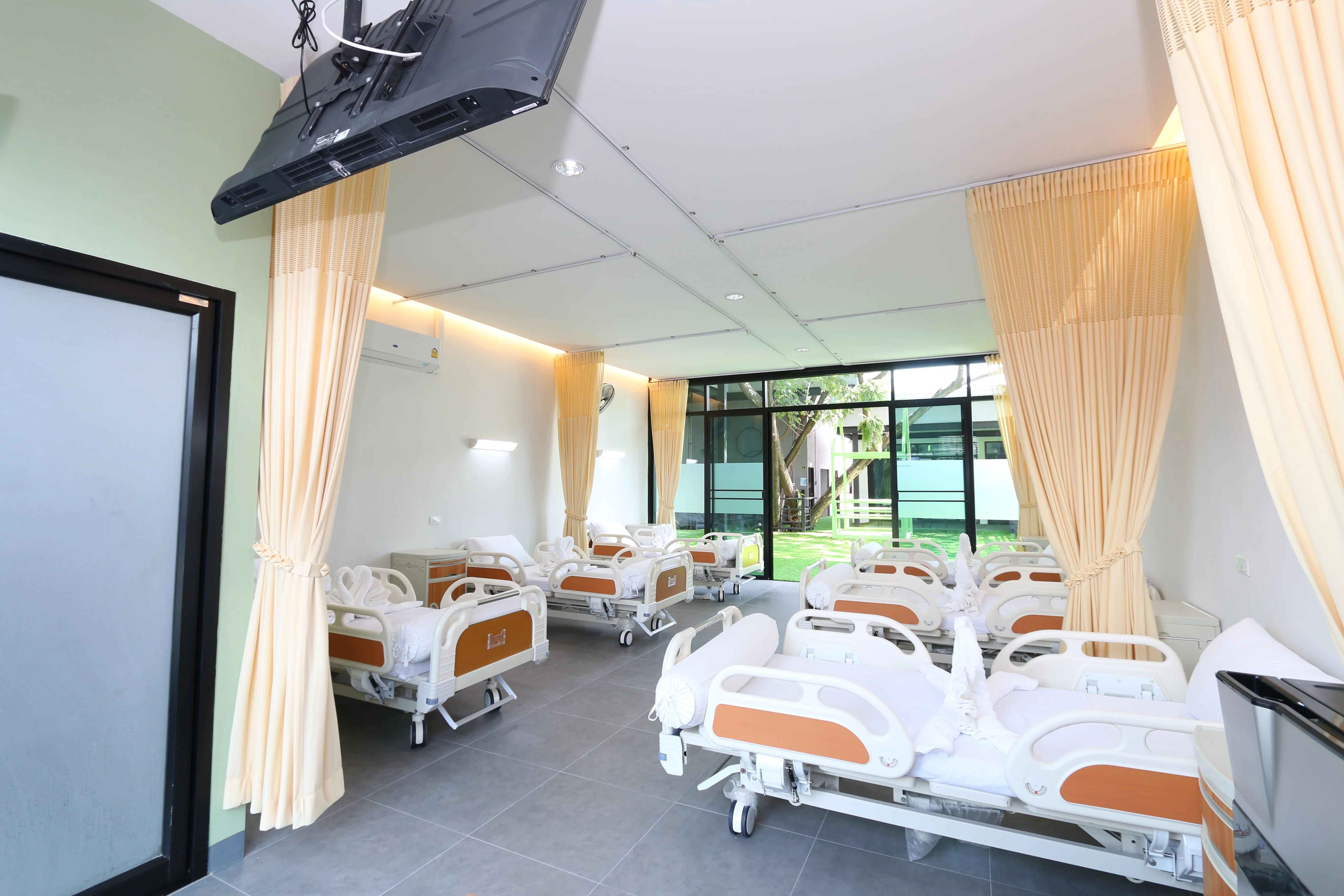
Shared room for patients on residential (overnight-stay) rehabilitation
Training at home: Physical therapy at home (095-767-6307) · Going home every evening but training every day: Day Care, come in the morning and go home in the evening · Caregiver exhaustion: Caregivers (nursing assistants) at home
5. Signs that rehabilitation is working, and when to ask for a plan review
Short answer: Look at change week by week compared with the previous week, not compared with before the illness. If several weeks pass with no visible change, ask the medical team to review the plan — do not stop training yet.
- Movement Better at making a fist and opening the hand on their own, able to pick up and release objects, standing balance lasts longer, walking distance increases
- Daily routines More able to eat, dress and use the toilet on their own
- Communication and swallowing Clearer speech, less choking
- Mood Wants to train, sleeps better, takes part in family life
- Hidden problems Memory, decision-making, vision and fall risk — have the team assess these before returning to driving or work
Ask the medical team to review the plan when
• Several weeks pass with no change in the target areas
• Severe dizziness, chest tightness or breathlessness during training — stop and tell the team immediately
• The hand is clenched tight and will not open, stiffness is increasing, the shoulder hurts, or joints are so stiff that training is not possible
• Coughing or choking while eating, a gurgling sound in the throat, or fever (risk of pneumonia)
• Drowsiness, crying easily, refusing to train, or trouble sleeping (this may be post-stroke depression, which is treatable)
If new symptoms appear suddenly — such as a drooping mouth, weakness in an arm or leg, slurred speech, unsteady walking, blurred vision or a severe headache — call 1669 (Thailand's emergency medical line) immediately. It may be another stroke.
6. The stroke rehabilitation plan at KIN, and finding the cause to prevent a recurrence
Short answer: A medical team covering 5 specialties, with doctors in 3 main fields — rehabilitation medicine, stroke (cerebrovascular disease) and geriatric medicine — visits patients every week, draws up an individual plan together with a multidisciplinary team of 8 professions, and looks into the cause of the stroke at the same time.
From the first day until going home
List of the medical team: see here · 1 caregiver for every 3–5 clients. Additional equipment such as TMS and aquatic therapy is available depending on the branch; the doctor decides based on the patient's condition, and it is charged separately. See rehabilitation technology at each branch · For prices and packages, see Stroke rehabilitation program
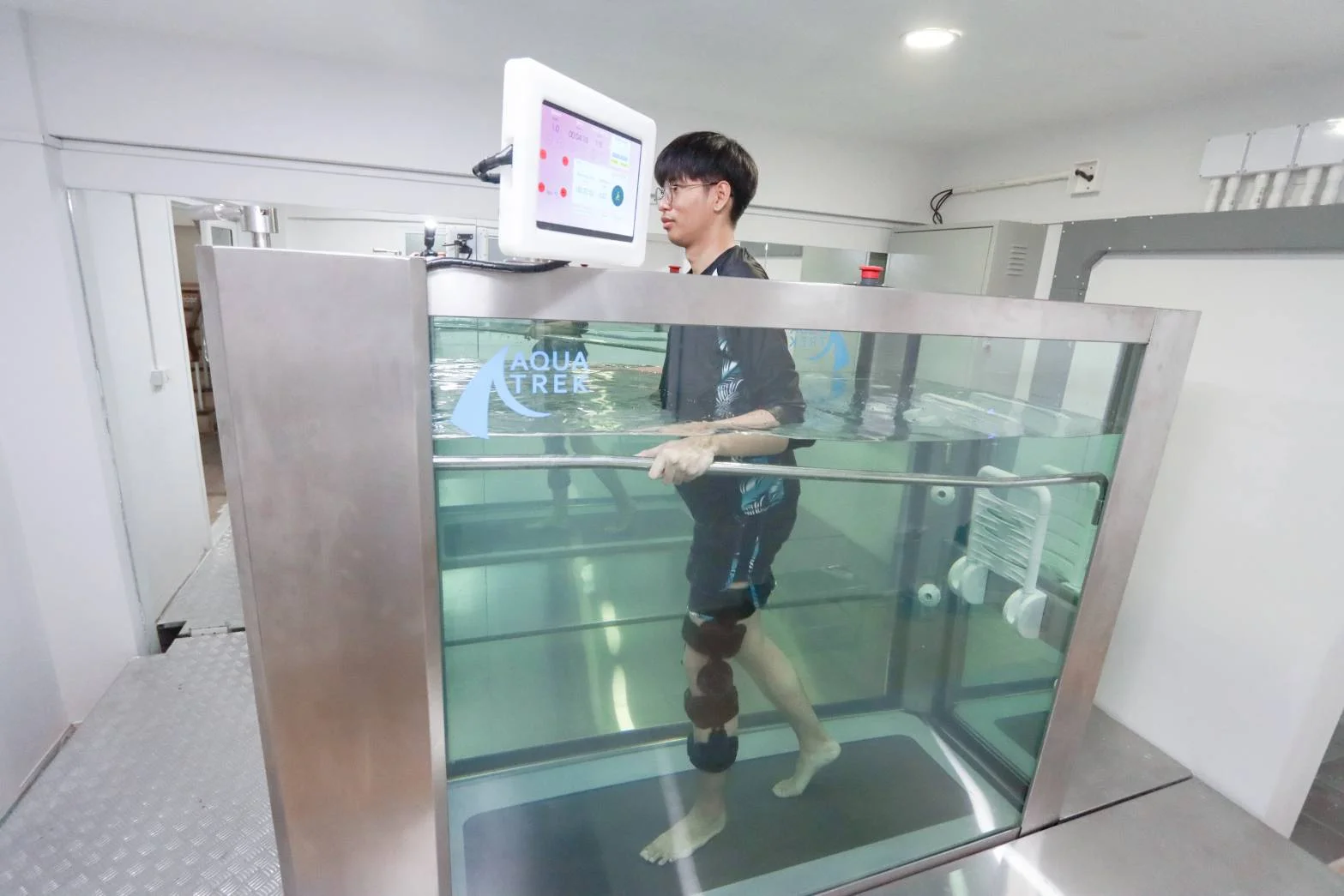
Underwater treadmill, KIN Lat Phrao 71
Finding the cause to prevent a recurrence: Diseases of the brain, heart and kidneys share vascular risk factors, so the doctor controls blood pressure, diabetes and cholesterol, does a basic electrocardiogram (EKG), monitors heart rhythm for longer in some cases, and considers a carotid artery ultrasound when indicated. At Sukhumvit 107, this is handled by Group Captain Dr. Talerngkiat Jam-U-Litrad (by appointment). See KIN Charnn Vascular Center and EECP (Thai)

“Families often ask how many more months until the patient can walk, and that cannot be answered with a single number. What the team can tell you is which phase the patient is in now, what next week's goal is, and that training should be as consistent as possible from the early period onwards.”
Contact us | Free consultation and visit
Consultations and center visits are available every day, 09:00–18:00, free of charge · First doctor's assessment THB 1,000
KIN Medical Hub Lat Phrao 71


KIN Physical Therapy Hospital, Sukhumvit 107
KIN Rehabilitation Center Pattaya
KIN Rehabilitation Center Ratchaphruek
KIN Ramkhamhaeng 24 — reserve a place before opening on 15 November 2026
KIN Salaya — reserve a place before opening on 15 December 2026
Central hotline: 02-096-4996 | Physical therapy at home 095-767-6307 | Care, nursing and equipment rental 061-881-9399 | In an emergency, call 1669
Frequently asked questions, answered by KIN's doctors and multidisciplinary team
How many months does stroke rehabilitation take?
There is no single number that applies to everyone. The first 3–6 months usually show the most visible change. After that, progress is still possible, but on average more training is needed. That is why the medical team assesses each person individually before planning.
How many phases does stroke have, and how long does each last?
The SRRR time framework (2017) divides recovery into 5 periods: 0–24 hours, 1–7 days, 7 days to 3 months, 3–6 months, and beyond 6 months. To make it easy to remember, these are shortened into 3 phases: acute, rehabilitation and ongoing.
If the stroke happened more than 6 months or even a year ago, can the patient still recover?
Progress is still possible. A 2026 study from Scotland in patients who had had their stroke for an average of almost three and a half years found that walking and sit-to-stand improved after 8 weeks of training, but it was a pilot study with no comparison group.
How many physical therapy sessions should there be per day?
There is no single number for everyone; the team sets it according to readiness and goals. At KIN, the standard is physical therapy once a day for 1 hour per session. If the doctor recommends more intensive training, this can be increased to 2–3 sessions a day. Occupational therapy and speech and swallowing therapy follow an individual plan.
Can we try rehabilitation before deciding?
Yes. A 1-week trial rehabilitation stay, THB 19,999, includes the room, meals, cleaning, bathing, 24-hour nursing team care, and physical therapy once a day for 1 hour per session. TMS and HBOT are not included.
- Agreed definitions and a shared vision for new standards in stroke recovery research: The Stroke Recovery and Rehabilitation Roundtable taskforce — International Journal of Stroke 2017 · Definitions, not an outcome study
- Update on Rehabilitation After Stroke: Global Changes and the Continued Importance of Therapy Intensity, Dose, and Timing — Stroke 2026 · Review article
- Heterogeneity in the Effectiveness of Rehabilitation Dose on Activities of Daily Living in Post-Acute Stroke — JAMDA 2026 · Observational data from Japan
- Effects of evidence-based early mobilization on prognostic outcomes in older patients with acute ischemic stroke — Frontiers in Public Health 2026 · Retrospective study
- Efficacy and safety of very early mobilisation within 24 h of stroke onset (AVERT) — The Lancet 2015 · Conducted in acute stroke wards
- Intensive, Multi-Technology Rehabilitation Programme for Chronic Stroke Survivors — Physiotherapy Research International 2026 · Single-group pilot
Medically reviewed by Dr. Kamolchat Chokthanomsap (Thai Medical Council licence 40854), KIN staff physician | Supervised by Dr. Thongchai Chokthanomsap, Executive Chairman | Last updated: 26 September 2026 | General information, not individual medical advice. Research figures are results for patients in the studies, not outcomes of KIN patients.